
Visit ME North East to get involved.
By Anita Roddam – ME Warrior
Visit ME North East to get involved.
“Grievous Bodily Harms”
(One of the many reasons why I’m an advocate for raising ME-Awareness)

You receive a letter from an official government body accusing you of an ‘offence’, purportedly committed in 1979 (38 years ago).
Your only defence – you were unaware that your action was an ‘offence’. (Ignorance is no defence in law)
Your understanding – at the time of the event it was not an ‘offence’ and probably is not today.
Notwithstanding, your livelihood and your reputation are at stake.
Despite suffering from cognitive impairments and multiple physical impairments, you have been immersed in assembling and presenting evidence to support your defence every day, for the past 5 months.
You cannot afford to pay for the services of a professional solicitor, lawyer or barrister to help you with this.
Throughout the case, your testimony has been disregarded variously as ‘hearsay’, ‘anecdotal’ and unproven without witnesses.
Any evidence which you have been able to provide, via your 5 witnesses, has not been believed and has been disregarded. This is despite having been told that their testimonies, specifically, are “VERY IMPORTANT”.
Even evidence previously generated by the system itself is also disregarded as too historical and not contemporary enough.
Finally, it is stated that there is “too much contradictory information from different sources to provide a robust defence and one that will accurately reflect the plaintiff’s position.”
Eventually, a person with some wisdom and experience in such cases advises you to seek a professional witness who could assist in your defence and who could provide written, formal, supporting evidence.
By then the judicial process has progressed and you are forced to undergo cross-examination.
Your requests for a paper-based review of your case are flatly refused.
As you are totally bedbound and only intermittently verbal, the cross-examination is to take place in your bedroom.
The judicial process has also been chaotic, unjust and incorrect and your health has further severely deteriorated.
At this point, instead of being declared unfit for trial, you are coerced into answering your case, as the only way for a decision to be reached (knowing that this will be harmful to your health and having informed the clerks of this).
One Sunday, in 2017, over 5 months since the onset of the prosecution, you are due to be questioned “Between 3–5 PM”.
At 7:24 AM you lie down to sleep for the “night” (suffering from sleep-onset delay, which has now become sleep-reversal. This fact is disregarded by the judicial process).
At 11:00 AM, after 3.5 hours’ sleep, you are woken as your night-time Carer leaves and your Senior Carer arrives to take over your care and, later, to give their testimony.
At 2:20 PM, with only half of your care needs met, your Senior Carer finishes assisting you to eat (spoon-feeding and assistance with drinks).
At 2:30 PM, your professional witness is due to arrive and another, second PA, arrives to support you with your physical care-needs, during and after the cross-examination, as your Senior Carer will be giving evidence.
By 2:46 PM, your professional witness has still not arrived and an urgent call is made.
Due to a miscommunication, the professional had thought that their services were not required. All haste is made for them to get to your home in time to give their evidence.
At 2:50 PM, you brief your Senior Carer on the running order of the day.
At 3:00 PM, the prosecutor is due to arrive.
At 3:05 PM, the professional witness arrives and hurriedly appraises the brief and the background to your case.
At 3:15 PM, As usual after eating, and worsened by the day’s exertions so far, you are overwhelmed with physical symptoms.
You are assisted to lie down.
The room is silent, dark and your eyes are covered.
You are experiencing a very severe adrenaline surge, tachycardia, palpitations, burning in the legs and face, neck pain, full-body pain, dehydration and sweats.
You are no longer able to speak and can only answer closed questions, asked by your Carer about your care needs, with a thumbs-up, “Yes”, or a wag of the index finger, “No”.
At 3:20 PM, the prosecution official arrives and is shown into the Carers’ bedroom (the only other available room you have).
At 3:27 PM, the official enters your bedroom and apologises for their visit. They express that it should have been “an open and shut case” and that they feel there should be no case to answer anyway.
Also, that they will hope to establish that you should not have to go through this again.
They will, nonetheless, need to hear the evidence from your 2 witnesses and ask if you are okay with this. You respond with hand signals. You are asked again, and manage to reply: “Yes”, and to thank them for coming. They leave the room and spend one hour recording the 2 witness testimonies.
Due to orthostatic intolerance You were only able to complete half of your nutritional needs before the 3:00 PM deadline. Although you suffer from hypoglycaemia, you have had to go without food for more than 2 hours beyond your safe limit, until the whole process of evidence-gathering is completed and the official has left.
At 1:15 PM on a Saturday, in 2017, three weeks later, you receive the verdict by post.
You are exonerated.
Your innocence is pronounced for an “ongoing period” (10 years).
However, you are obviously thought of as a potential recidivist as your name is placed on some kind of offenders’ register, whereby your case can be reviewed at any time, “should your circumstances change”.
Even so, you/I’m nothing less than gleeful and highly relieved.
At 4:15 PM, the room starts to tilt and to swirl, violently.
I experience an acute onset of severe vertigo, accompanied by heat surges, icy cold skin, and bouts of diarrhoea & vomiting (of some blood), after which I pass out whilst still propped against my pillows. I open my eyes after an hour and pass out again for a further half hour.
Today, January 2018 :
I am still in PEM/PENE (post-exertional neuroimmune exhaustion).
I don’t have relapses and remissions, just deteriorations from which I do not recover.
Oh, and you’re probably wondering – what was my supposed ‘crime’?
In November 1979, I became seriously ill.
In the late 1970s, and onwards, this was not considered to be an offence by the general population, nor the UK government.
By 1991, however, there began a never-ending series of denials of my condition, scrutiny and accountability, reviews, appeals and tribunals, all of which I have won, and my benefits and rights have been reinstated every time.
And what triggered this latest, farcical onslaught of harassment?
I was “invited by the DWP (Department of Work and Pensions) to transfer my ‘lifetime’ award of DLA (Disability Living Allowance) to PIP (Personal Independence Payment).”
The treatment that I have been subjected to has been that which may be meted out to a criminal offender.
The harassment of a person suffering from severe, chronic and deteriorating conditions has been brutal, and I would hope that, within the criminal justice system, there are protections in place against such ill-treatment of accused persons.
And… what… an… enormous… waste… of… public… funds…!
The cost to my health of this, and the past 29 years of persecutions, however, has been catastrophic.
This experience will not be easily forgotten.
And, by me and my body, not forgiven.
A criminal offence did, in fact take place:
A disability hate crime.
Prolonged institutional harassment and discrimination
by dint of a person’s disabilities and illnesses.
Ignorantia juris non excusat
Ignorance of my condition is no defence either.
Barely able to be upright long enough to eat
Can’t move in the bed for the repositioning of pressure care fleeces
Can’t ‘dip’ head forward for placement of headsupport pillow
Extreme upperbody pain
Can’t reach far enough for toilet items
Can’t look down without disabling pain in the eyes
Motion sickness and nausea
Overwhelming brain-fog
Episodes of weeping
Anxiety
Today: still a WARRIOR.
Persecution pəːsɪˈkjuːʃn
Noun:
persecution; plural noun: persecutions
hostility and ill-treatment, especially because of race or political or religious beliefs; oppression.
synonyms: oppression, victimization, maltreatment, ill-treatment, mistreatment, abuse, ill usage, discrimination, tyranny, tyrannization, punishment, torment, torture; pogrom;
informal witch hunt;
informal red-baiting
harassment, hounding, harrying, badgering, teasing, bullying, molestation
costly ˈkɒs(t)li
adjective
costing a lot; expensive.
“major problems requiring costly repairs”
synonyms: expensive, dear, high-cost, high-priced, highly priced, big-budget, overpriced, exorbitant, extortionate, immoderate, extravagant; causing suffering, loss, or disadvantage.
“the government’s biggest and most costly mistake”
synonyms: catastrophic, ruinous, disastrous, calamitous, cataclysmic, devastating, crippling, crushing, fatal, lethal, damaging, harmful, injurious, deleterious, woeful, grievous, lamentable, dire, awful, terrible, unfortunate; literary: direful
(A gentle warning in case this may trigger PTSD in some people)
At 8.30am on November 20th 1993, 14 years into Severe ME & Multiple Chemical Sensitivity and 97% bedbound, I woke to find my bedroom filled with very strong paint fumes, the vaporised lead from the paint stripping and gas fumes (possibly carbon monoxide) from the heated paint stripper.
The workmen trespassing in my garden, in order to paint the upper flat, refused to stop working until I could escape the building.
Shortly after this, although rescued by friends who came and collected me, I was flat on my back in their entryway, unable to climb the stairs to their apartment even when supported under the arms on either side. I was taken to hospital by the kindliest and most solicitous paramedics and there told that paint fumes at these dilutions “couldn’t possibly affect me this severely.”
What followed was a massive adrenaline response which lasted for over 2 years.
There was pandemonium in my brain. It felt like a tiger was going to come through the window at every moment, like I was running through a burning building screaming and looking for my children.
The effect on my brain chemistry was intolerable.
I couldn’t stand any activity for more than 3-4 minutes.
I had to alternate between listening to the radio, lying in silence and looking at a distant television screen without the volume. My brain felt like it was completely demented, on fire, but I, Anita, was calm.
The handwritten letter below is what I wrote in the dead of night, with my left hand, on the hospital ward. I couldn’t use any other part of my body at all.


I’ve been unable to sit up, or hold up my head unsupported ever since.
That was when my life ended.
I’m not sure what to call it now…
I’m not at all depressed, you understand, it’s just a fact.
“It’s life Jim, but not as we know it.”
I’m starting to write this at 4 o’clock in the morning. I have sleep reversal, and today, August 8th, is Severe M.E Understanding and Remembrance Day, 2017.
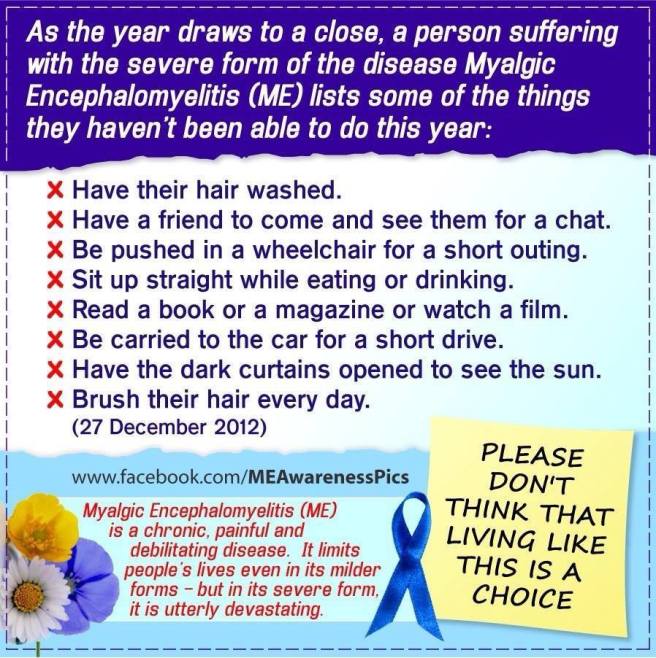
This first photograph is not my story, but it’s a good enough start.
2 nights ago, seeking support, I posted in a Facebook group, under the heading: “Injured”, that I had damaged my ribs, asking if anyone would be awake late, very late.
People were lovely and kind, some offering a number of solutions.
What the responses made me realise, however, is that I hadn’t done a very good job of explaining the severity of my condition generally. In fact, in crisis due to the injury, I hadn’t been able to explain anything at all.
When I joined the group, I never introduced myself and didn’t explain that I have a profoundly severe case of M.E. So, it feels a little bit like it might if one was gay and not ‘out’. Everybody’s assuming how I identify and offering solutions based on that mindset.
So, in honour of inclusivity and Severe M.E Understanding and Remembrance Day, I’m coming out, but just a little to save on your patience:
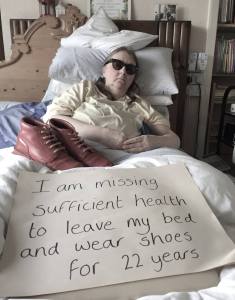
I haven’t left my home, bedroom or bed, since 1993, apart from an imposed house move, by ambulance and stretcher in 2003.
For 25 years I’ve been 100% bedbound and “bodybound” – barely able to move in the bed and only occupying two positions, either lying on my left side, or propped by pillows, reclining for just long enough to eat.
At a very early point it was threatened that I would be removed from the practice list if I requested a home visit.
The GPs refused to visit for 23 years “unless there was a medical need” . That is, they would come out to assess e.g a chest infection but there would be no management of my condition of severe and profound M.E.
I’ve recently actually been visited by a new GP, after the old ones retired (but only because of another acute injury) who has offered to visit me once a year – Big Deal!
I only gained access to the Internet in the spring of 2016 and find that most of the M.E groups on Facebook are solutions-orientated.
After the cumulative effects of 38 years I’m physically fragile, and exhausted beyond belief, and cannot even tolerate someone else helping. No interventions are possible.
I’m intolerant to all medication and frequently experience an inverse or idiosyncratic reaction. I’m barely able to move and can’t soak in the tub, visit a chiropractor or even apply creams designed to relieve the pain and inflammation.
Due to the severity and chronicity of my M.E I wasn’t/am not able to take any action whatsoever to alleviate or treat the extreme and acute pain caused by the injury.
The reason that I’m writing this is that, I’m sincerely glad for those who are able to follow protocols and improve their quality of life, but we need to be aware that this is not the case for everyone in these groups.
There are those of us still out here for whom nothing has changed, because nothing is able to be changed.
We are invisible, ignored and sidelined and for the sake of inclusivity I’m hoping to make people living with very Severe M.E a little less invisible, once again, today.

This banner was displayed on my behalf outside the Department for Health, London UK, at the 25% Severe ME Group protest on World ME Awareness Day, May 12th 2003.
 Anita's Actions